
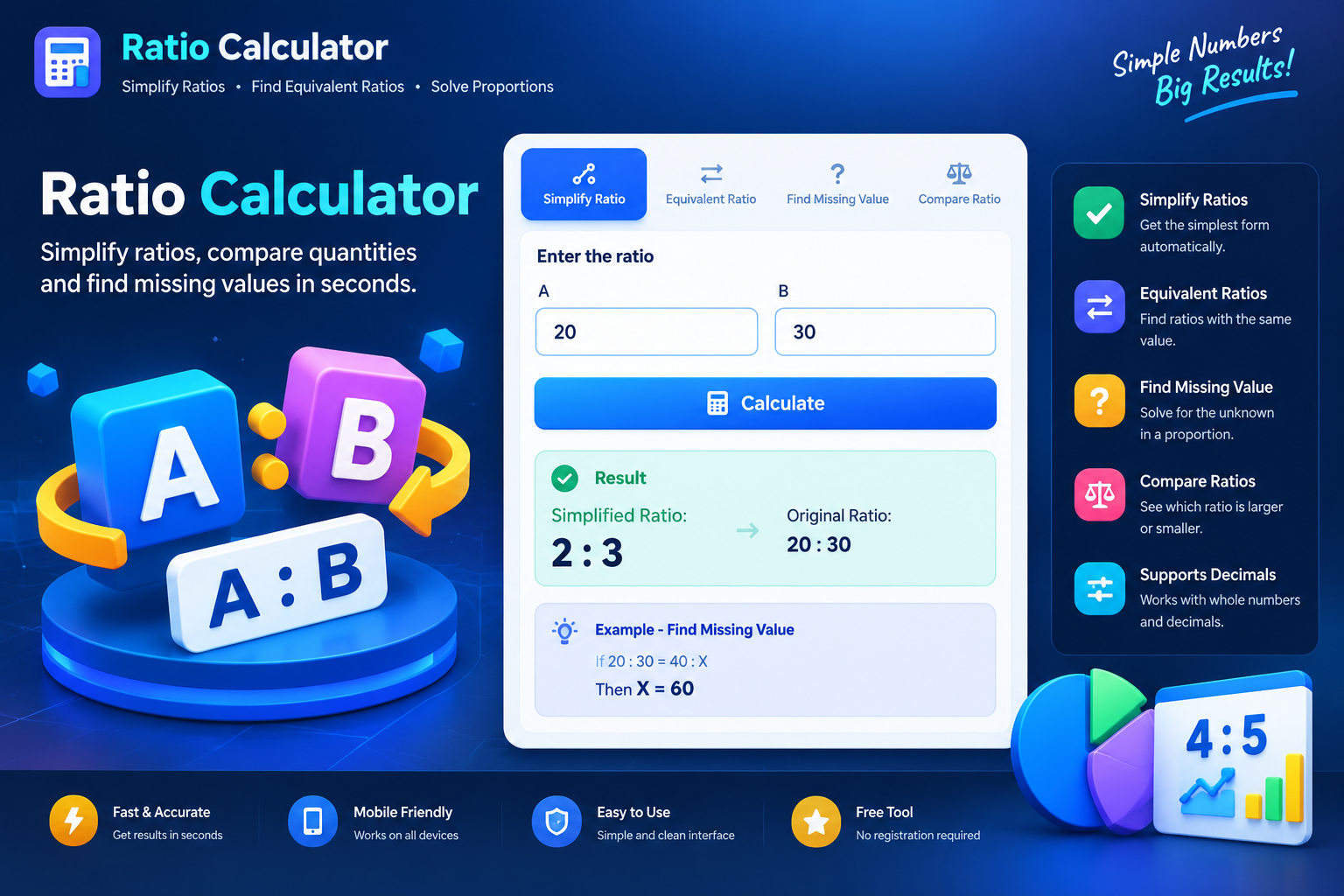
Ratio Calculator
Simplify ratios, solve missing values, compare proportions, and scale ratios with our free calculator.
Simplify a Ratio
Find the Missing Ratio Value
Enter three values. Leave the unknown value empty.
Compare Two Ratios
Scale a Ratio
A ratio is a useful way to compare two or more quantities while keeping their relative relationship clear. Our Ratio Calculator makes common ratio calculations easier by helping you simplify ratios, find an unknown value, check whether two ratios are equivalent, and scale a ratio up or down.
For example, if the ratio of red balls to blue balls is 2:3, the calculator can help you determine an equivalent ratio such as 10:15, simplify a ratio such as 20:30 to 2:3, or solve a missing value in a proportion.
Whether you are working on a math problem, adjusting a recipe, calculating a mixture, or comparing quantities, understanding ratios can make these calculations much simpler.
Simplify Ratios
Simplifying a ratio means reducing its numbers while keeping exactly the same relationship between the quantities.
For example, consider the ratio:
24:36
Both numbers can be divided by their greatest common factor, which is 12:
24 ÷ 12 = 2
36 ÷ 12 = 3
Therefore:
24:36 = 2:3
The simplified ratio 2:3 represents the same relationship as 24:36, but it uses smaller numbers.
To simplify a ratio with the calculator, enter the two values and select the simplify option. The calculator determines an appropriate common factor and displays the reduced ratio.
Ratios can also contain decimal values. When working with decimals, it may be useful to first convert the terms into equivalent whole-number values before reducing them.
Example
Suppose a mixture has a ratio of 15:25.
The greatest common factor is 5:
15 ÷ 5 = 3
25 ÷ 5 = 5
So the simplified form is:
3:5
The important point is that both terms must be divided by the same factor. Dividing only one side changes the relationship and produces a different ratio.
Solve for the Missing Ratio Value
A ratio problem often gives you three known values and asks you to determine the fourth.
For example:
3:5 = 12:x
Here, x is unknown.
You can solve the problem by setting up a proportion:
3/5 = 12/x
Cross-multiplying gives:
3x = 5 × 12
3x = 60
Now divide both sides by 3:
x = 20
Therefore:
3:5 = 12:20
The same idea can be used when a different position in the ratio is unknown. The key is to preserve the order of the corresponding terms.
Another Example
Suppose:
4:7 = x:21
The unknown value can be found by comparing the scale between 7 and 21.
Since:
21 ÷ 7 = 3
multiply the other term by 3:
4 × 3 = 12
Therefore:
x = 12
And the completed ratio is:
4:7 = 12:21
A ratio calculator can perform these calculations automatically and show the resulting value.
Evaluate Equivalent Ratios
Two ratios are equivalent when they describe the same proportional relationship.
For example:
2:3
and
8:12
are equivalent.
To see why, divide the second ratio by the same factor:
8 ÷ 4 = 2
12 ÷ 4 = 3
So:
8:12 = 2:3
Another way to check two ratios is to treat them as fractions:
2/3
and
8/12
The second fraction can be reduced:
8/12 = 2/3
Because both ratios produce the same simplified fraction, they are equivalent.
The calculator can compare two ratios and determine whether they represent the same relationship. When they are not equivalent, comparing their fractional values also shows which ratio represents the larger relative quantity.
Quick Rule for Equivalent Ratios
If you multiply or divide every term in a ratio by the same nonzero number, you create an equivalent ratio.
For example:
3:4 × 5 = 15:20
Therefore:
3:4 = 15:20
This rule is useful when increasing quantities while keeping their proportions unchanged.
Practical Example: Concrete Mix Ratios
Ratios are frequently used when different materials need to be combined in specific proportions.
Suppose a concrete mixture uses a volume ratio of:
1:2:3
This means:
- 1 part cement
- 2 parts sand
- 3 parts gravel
The exact quantities can change, but the relationship between the three materials should remain consistent when you are scaling the mixture.
Imagine that you have 8 buckets of sand and want to determine the corresponding amount of cement and gravel.
The original ratio is:
1:2:3
The sand represents 2 parts. If 2 parts correspond to 8 buckets, then one part is:
8 ÷ 2 = 4 buckets
Now calculate the other materials:
Cement:
1 × 4 = 4 buckets
Gravel:
3 × 4 = 12 buckets
So the required quantities are:
4 buckets cement : 8 buckets sand : 12 buckets gravel
The scaled ratio remains:
1:2:3
The important idea is that the same scale factor is applied to every part of the ratio.
Note: Real concrete mix requirements can depend on the application, materials, strength requirements, local standards, and professional specifications. A simple ratio example should not be treated as an engineering specification.
Practical Example: Scaling a Recipe
Ratios are also helpful in cooking when you need to prepare more or less food than the original recipe produces.
Suppose a recipe requires:
1 cup flour : 2 cups milk : 3 cups water
This is a ratio of:
1:2:3
If you want to make twice as much, multiply every quantity by 2.
Flour:
1 × 2 = 2 cups
Milk:
2 × 2 = 4 cups
Water:
3 × 2 = 6 cups
The new recipe becomes:
2:4:6
This is equivalent to the original 1:2:3 ratio.
You can use the same method when making a recipe smaller. For example, multiplying every ingredient by 0.5 produces half the original quantity:
1 × 0.5 = 0.5
2 × 0.5 = 1
3 × 0.5 = 1.5
The resulting amounts are:
0.5 cup flour : 1 cup milk : 1.5 cups water
The proportions remain unchanged.
About Ratios
A ratio compares quantities in terms of their relative sizes. Ratios are commonly written using a colon, such as:
5:8
This is read as “5 to 8.”
Ratios can compare two quantities or several quantities at once.
For example:
4:7
compares two quantities, while:
2:3:5
compares three quantities.
Part-to-Part Ratios
A part-to-part ratio compares one quantity with another quantity within a group.
Suppose a box contains 6 red pens and 9 blue pens.
The ratio of red pens to blue pens is:
6:9
This can be simplified to:
2:3
That means for every 2 red pens, there are 3 blue pens.
The ratio focuses on the relationship between the two groups rather than the total number of pens.
Part-to-Whole Ratios
A part-to-whole ratio compares one part with the entire group.
Using the same example, there are:
6 red + 9 blue = 15 pens
Therefore, the ratio of red pens to all pens is:
6:15
This can be simplified to:
2:5
The same idea can be expressed as a fraction:
6/15 = 2/5
So red pens make up 2/5 of the total.
Understanding the difference between part-to-part and part-to-whole ratios is important because the denominator changes depending on what you are comparing.
Convert Ratio to Fraction
A ratio can be related to fractions, but the correct conversion depends on what the ratio represents.
Consider the part-to-part ratio:
1:2
The two parts contain a total of:
1 + 2 = 3 parts
Therefore, the first part represents:
1/3
of the whole, while the second part represents:
2/3
of the whole.
How to Convert a Ratio into Fractions
For a ratio such as:
2:3
follow these steps:
- Add the ratio terms: 2 + 3 = 5
- Use the total as the denominator.
- Write each original ratio term over the total.
So:
2:3 → 2/5 and 3/5
Together:
2/5 + 3/5 = 1
This works because the two ratio parts make up the complete whole.
Important Difference
A ratio such as 2:3 does not automatically mean 2/3 of the whole.
If 2:3 describes two parts of one complete group, there are 5 total parts. In that situation:
2:3 → 2/5 and 3/5 of the whole
However, 2/3 can be the correct fraction when the ratio is being interpreted as a direct comparison between the first quantity and the second quantity.
The context therefore matters when converting ratios to fractions.
Related Calculators
If you are working with ratios, proportions, and fractions, other mathematical calculators can also be useful.
Ratio Simplifier
Use a ratio simplifier when you only need to reduce a ratio to its simplest form.
Ratio to Fraction Calculator
A ratio-to-fraction tool can help convert ratio relationships into fractional representations, particularly when working with parts of a whole.
Aspect Ratio Calculator
An aspect ratio calculator is useful for comparing the width and height of images, screens, videos, displays, and other rectangular objects.
Fraction Calculator
For calculations involving addition, subtraction, multiplication, division, or reduction of fractions, a dedicated fraction calculator can make the process faster.
Frequently Asked Questions
What is a ratio?
A ratio is a way to compare two or more quantities according to their relative sizes. It is commonly written using a colon, such as 3:5.
How do I simplify a ratio?
Divide all terms by their greatest common factor. For example, 18:24 becomes 3:4 after dividing both terms by 6.
How do I find a missing value in a ratio?
Set the two ratios equal to each other and solve the resulting proportion. Cross multiplication is a common method for finding the unknown value.
What makes two ratios equivalent?
Two ratios are equivalent when they represent the same proportional relationship. For example, 2:5 and 8:20 are equivalent because both reduce to 2:5.
Can ratios contain decimals?
Yes. Ratios can represent decimal quantities as well as whole numbers. Depending on the calculation, decimals can often be converted into equivalent whole-number ratios.
What is the difference between a ratio and a fraction?
A ratio compares quantities, while a fraction commonly represents a part of a whole. A ratio can sometimes be expressed using fractions, but the correct interpretation depends on the context.
Can a ratio have three terms?
Yes. A ratio can compare three or more quantities. For example, 1:2:4 represents three related quantities.
Why should I use the same multiplier for every ratio term?
Multiplying every term by the same number preserves the original relationship. Changing only one term produces a different ratio.
Conclusion
Ratios are a simple but powerful way to compare quantities and maintain proportional relationships. They can be used in mathematics as well as everyday situations such as recipes, mixtures, measurements, scale drawings, and quantity comparisons.
With a ratio calculator, you can quickly simplify ratios, solve missing values, test whether two ratios are equivalent, and scale multiple quantities while keeping their original proportions intact.
The most important rule to remember is simple: when changing a ratio, apply the same multiplier or divisor to every corresponding term. This keeps the relationship consistent and allows you to create equivalent ratios with confidence.