
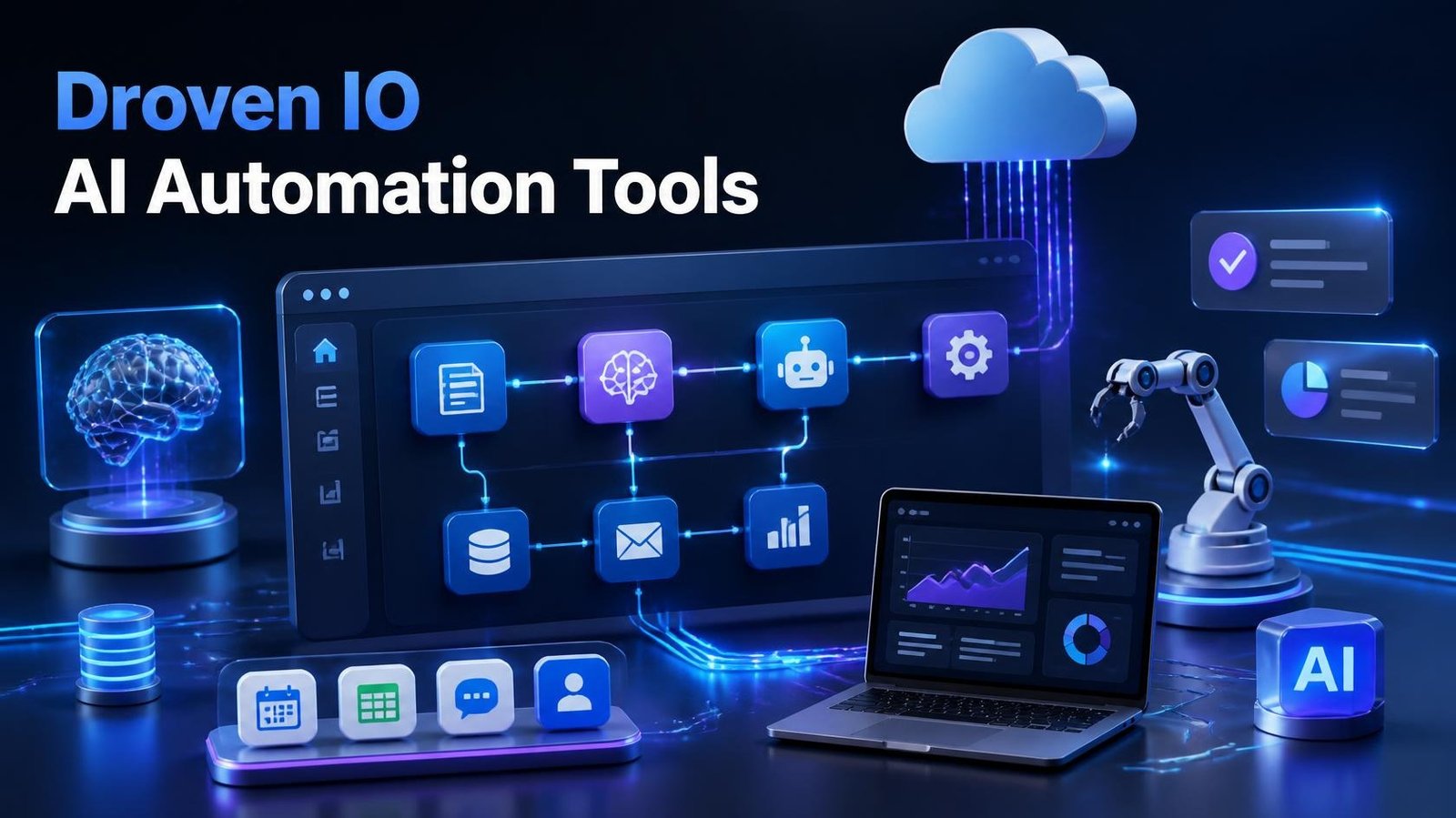
Artificial intelligence and automation are changing how businesses handle repetitive tasks, customer communication, data processing, marketing, and everyday operations. As more companies adopt AI-powered workflows, people are searching for reliable information about automation platforms and how these technologies work.
One search term that has gained attention is Droven IO AI Automation Tools. The name can be confusing because it may sound like a specific automation software product. In practice, Droven.io is presented as an informational technology platform that covers artificial intelligence, automation, robotic process automation (RPA), digital transformation, and related technologies.
This guide explains what Droven.io is, what “Droven IO AI automation tools” means, how AI automation works, the major types of tools involved, and how businesses can use them.
What Is Droven.io?
Droven.io is an informational platform focused on technology topics, including artificial intelligence, automation, RPA, AI in business, digital transformation, and emerging technologies.
It is important to distinguish between Droven.io as an information resource and the actual software platforms that perform automation.
Droven.io provides information that can help readers understand AI and automation concepts. The actual automation of business processes is performed by separate software platforms, workflow systems, RPA applications, AI models, and integrations.
This distinction is important for anyone searching for a Droven.io automation tool or expecting to find a software dashboard.
What Does “Droven IO AI Automation Tools” Mean?
The phrase Droven IO AI Automation Tools is best understood as a search topic relating to the AI automation technologies and platforms discussed in connection with Droven.io.
These technologies can include several different categories:
- Workflow automation platforms
- AI-powered assistants
- Robotic process automation
- AI agents
- CRM automation
- Conversational AI
- Data-processing systems
- Large language model applications
- Business process automation
Each category serves a different purpose.
For example, workflow automation connects different applications and moves information between them, while RPA can automate repetitive interactions with software. AI systems can add capabilities such as text understanding, classification, summarization, and decision support.
How AI Automation Works
Traditional automation usually follows predefined instructions.
For example:
When a customer submits a form → add the information to a spreadsheet → send an email.
AI automation can introduce an additional layer of intelligence.
A more advanced workflow could look like this:
Customer submits a message → AI reads the message → identifies the customer’s request → categorizes it → creates a response → sends the information to the appropriate system.
This makes AI automation different from simple rule-based automation.
The system can process information that is less structured, such as emails, documents, customer messages, or natural-language requests.
Main Types of AI Automation Tools
1. Workflow Automation Platforms
Workflow automation platforms connect different applications and allow information to move automatically between them.
A business might connect:
- CRM software
- Spreadsheets
- Forms
- Customer-support systems
- Project-management software
- Databases
These connections can reduce repetitive manual work.
2. Robotic Process Automation
Robotic Process Automation, commonly called RPA, is designed to automate repetitive, rule-based computer tasks.
RPA can be useful for activities such as:
- Copying information between systems
- Processing structured documents
- Updating records
- Generating routine reports
- Entering information into business applications
RPA is particularly useful when a process follows consistent rules.
3. AI-Powered Workflow Automation
AI can make automated workflows more flexible.
Instead of requiring every possible situation to be manually programmed, an AI model can analyze information and determine which predefined workflow should be triggered.
For example, an AI system could classify incoming customer emails into categories such as:
- Sales inquiry
- Technical support
- Billing question
- Complaint
- General information
The workflow can then send each category to a different process.
4. AI Agents
AI agents are designed to perform multiple steps toward a specific objective.
Depending on the system, an agent may interpret a request, retrieve information, use connected tools, perform actions, and return a result.
For businesses, agents can potentially assist with research, customer support, internal information retrieval, and other multi-step processes.
Because agents can take actions, businesses should establish appropriate permissions, monitoring, and human approval for sensitive operations.
5. Conversational AI
Conversational AI allows people to interact with software through natural language.
Businesses can use conversational systems for:
- Frequently asked questions
- Customer support
- Lead qualification
- Appointment assistance
- Internal employee support
- Product information
A conversational system can be connected to company information so that it can provide more relevant responses.
How Businesses Use AI Automation
AI automation can be applied to many business processes.
Customer Support
AI can classify incoming requests, answer common questions, summarize conversations, and route complex issues to human employees.
Lead Management
When a new lead arrives, an automated workflow can collect the information, categorize the lead, update a CRM, and notify a sales representative.
Document Processing
AI can extract information from invoices, forms, applications, contracts, and other documents.
Marketing
Marketing teams can use automation for content workflows, customer segmentation, email campaigns, reporting, and campaign analysis.
Data Management
AI can help classify, summarize, organize, and process large amounts of information.
Internal Operations
Businesses can automate routine notifications, reports, approvals, task assignments, and information requests.
Benefits of AI Automation
Saves Time
Automation reduces the amount of manual work required for repetitive tasks.
Reduces Repetitive Work
Employees can spend less time performing routine data-entry and information-processing activities.
Improves Workflow Consistency
Automated processes can follow the same predefined steps each time.
Handles Large Amounts of Information
AI systems can process large volumes of text and structured or unstructured information more quickly than manual processing in many situations.
Supports Employees
AI automation does not necessarily need to replace human workers. It can instead handle repetitive parts of a process while employees focus on tasks requiring judgment, communication, creativity, or specialized knowledge.
AI Automation vs Traditional Automation
The main difference is how the system handles information.
Traditional automation generally depends on clearly defined rules.
For example:
If an order is received → update the database.
AI automation can process less structured information.
For example:
Read a customer email → understand the request → identify the category → select the appropriate workflow.
This makes AI useful for tasks involving natural language and unstructured information.
However, AI also introduces additional risks because its interpretation may not always be correct.
Advantages and Limitations
AI automation can provide significant benefits, but businesses should understand its limitations.
Advantages
- Faster processing
- Less repetitive manual work
- Improved workflow efficiency
- Ability to process unstructured information
- Easier integration of AI into business processes
- Support for employees
Limitations
- AI can make mistakes
- Complex workflows require careful configuration
- Sensitive information requires appropriate security controls
- Automation can fail when systems or integrations change
- AI-generated decisions may require human review
- Poorly designed automation can create new problems instead of solving existing ones
For important business processes, human oversight can remain an important part of the workflow.
How to Choose an AI Automation Tool
If you are researching AI automation platforms discussed in connection with Droven.io, start by identifying the process you want to automate.
Consider these questions:
What task are you automating?
Be specific. “Improve productivity” is too broad. “Automatically classify customer emails and route them to the correct department” is a clearer automation goal.
How repetitive is the process?
Automation is generally most useful when a task occurs frequently and follows a reasonably consistent process.
Does the platform integrate with your software?
Check whether the automation system works with the applications your business already uses.
How much human involvement is required?
Some workflows can operate automatically, while others should include human approval before an important action is completed.
How is data protected?
Review security and privacy information before sending confidential business information to an AI service.
Is Droven.io an AI Automation Software?
Based on its public positioning, Droven.io is better understood as an informational technology platform rather than a conventional AI automation SaaS product.
It discusses and explains areas such as AI, RPA, automation, and digital transformation. The actual software used to execute automated workflows comes from separate technology providers.
This distinction helps avoid confusion between a website that explains automation and a platform that actually runs automation workflows.
Who Can Benefit From Learning About AI Automation?
AI automation information can be useful for several audiences.
Small Businesses
Small businesses can learn how automation may reduce repetitive administrative work.
Entrepreneurs
Business owners can explore different automation approaches before selecting software or hiring an automation specialist.
Marketing Teams
Marketing professionals can learn how AI can support content, customer communication, lead management, and reporting.
IT Professionals
Technology teams can evaluate workflow automation, RPA, AI agents, and system integrations.
Students and Beginners
People who are new to AI can use informational resources to understand basic concepts before learning specific platforms.
Frequently Asked Questions
What is Droven IO AI Automation Tools?
The term refers to AI automation technologies and platforms discussed in relation to Droven.io. Droven.io itself is presented as an informational technology platform rather than a conventional automation application.
Does Droven.io run business automations?
Droven.io is not primarily presented as software that executes business workflows. Its role is informational, covering AI, automation, RPA, and related technologies.
What are AI automation tools used for?
They can automate tasks involving customer support, data processing, marketing, document handling, CRM updates, reporting, and other repetitive business processes.
What is the difference between AI and RPA?
RPA primarily automates structured, repetitive, rule-based computer tasks. AI can add capabilities such as language understanding, classification, summarization, and pattern recognition.
Can AI automation work without human involvement?
Some low-risk tasks can be highly automated. However, sensitive, complex, or high-impact processes may benefit from human review and approval.
Is AI automation suitable for small businesses?
It can be useful when a business has repetitive processes that consume significant time. The best starting point is usually a clearly defined workflow with measurable benefits.
Conclusion
Droven IO AI Automation Tools is a topic centered on understanding the growing field of artificial intelligence and business automation.
Droven.io itself is best understood as an informational resource covering technologies such as AI, RPA, automation, and digital transformation. The actual execution of automated workflows is handled by separate software platforms and AI systems.
For businesses considering automation, the most important step is to identify a specific repetitive process, understand its requirements, choose compatible technology, and introduce appropriate human oversight.